AI Factory Manufacturing: Samsung's Blueprint for UK Manufacturers
Samsung Electronics made waves this week with an announcement that should concern every UK manufacturer still thinking through their digital transformation strategy. The South Korean giant declared it will transition all global manufacturing operations into 'AI-Driven Factories' by 2030. This means deploying agentic AI, digital twins, and autonomous robotics across its entire production network.
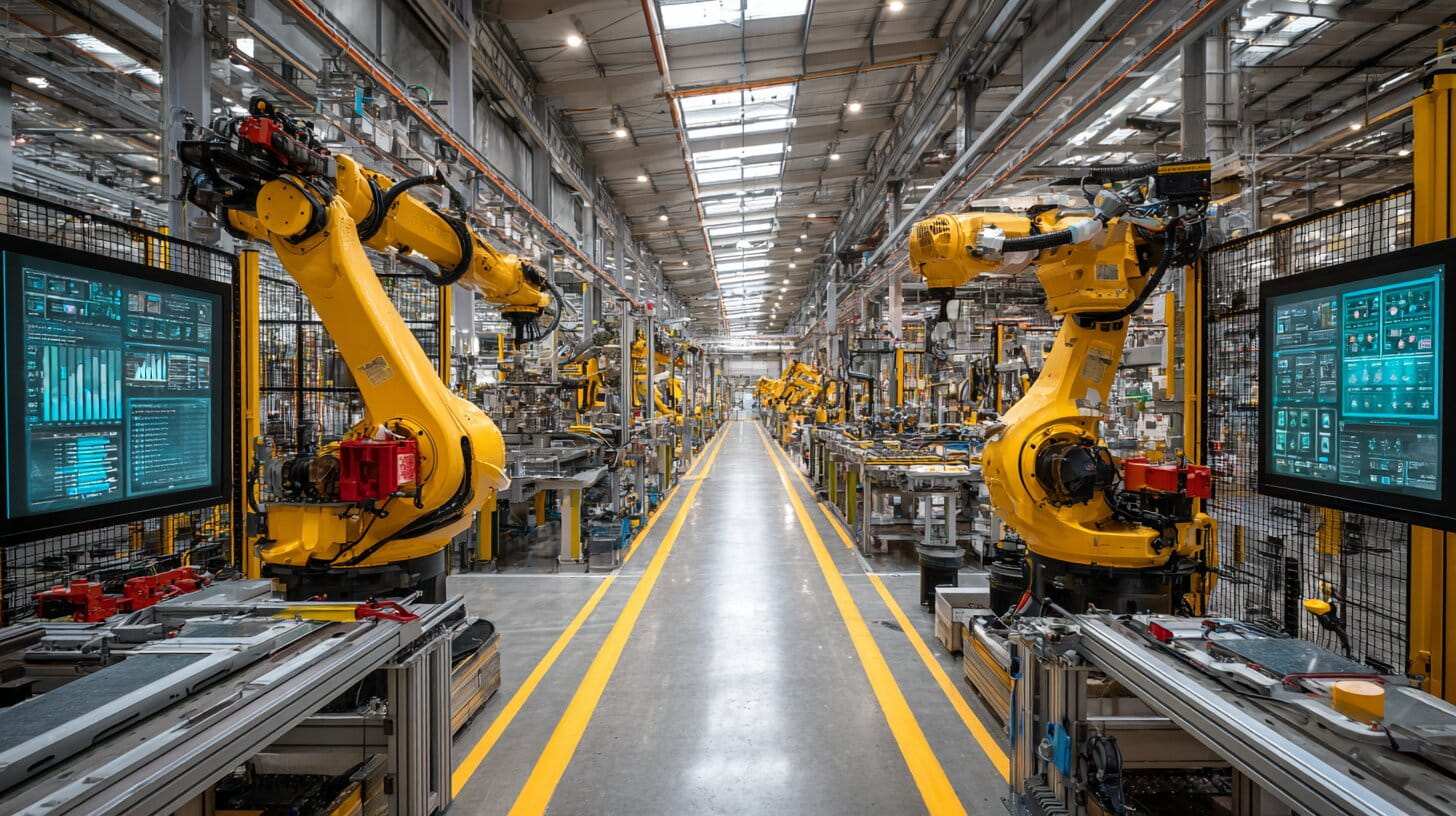
Samsung Electronics made waves this week with an announcement that should concern every UK manufacturer still thinking through their digital transformation strategy. The South Korean giant declared it will transition all global manufacturing operations into ‘AI-Driven Factories’ by 2030. This means deploying agentic AI, digital twins, and autonomous robotics across its entire production network.
This is not another corporate press release about vague AI ambitions. Samsung is committing to a fundamental restructuring of how industrial value is created. While British manufacturers debate pilot programmes and incremental upgrades, the world’s leading industrial nations are racing ahead with AI factory manufacturing at scale.
The Samsung AI Strategy: What ‘AI-Driven Factory’ Actually Means
Samsung’s announcement centres on three connected technologies that will define manufacturing competitiveness over the next decade.
Agentic AI Manufacturing: Beyond Analysis to Autonomous Action
The cornerstone of Samsung’s strategy is ‘Agentic AI’ (first introduced in its Galaxy S26 series for consumer applications), now being extended to industrial operations. Unlike conventional AI that analyses data and generates recommendations, agentic AI manufacturing systems plan, execute, and optimise decisions on their own to achieve defined goals.
In practical terms, this means AI agents that do not simply flag a supply chain delay or a spike in machine temperature. They reason through the implications, plan corrective actions, and re-optimise production schedules in real time. Samsung will deploy specialised AI agents dedicated to quality control, production, and logistics, all operating with minimal human oversight.
Gartner predicts that 40% of enterprise applications will embed task-specific AI agents by the end of 2026, up from less than 5% in 2025. The market for agentic AI is projected to surge from $7.8 billion today to over $52 billion by 2030. Samsung is positioning itself at the forefront of this shift.
Digital Twin Manufacturing UK: The Factory’s Operating System
Samsung will implement digital twin-based simulations throughout its manufacturing processes. These span materials warehousing to production and shipment. These are not static 3D models but living digital replicas that mirror every physical asset and energy load in real time.
The global digital twin market has surpassed $36 billion and is projected to reach $240 billion by 2035, growing at a compound annual rate exceeding 30%. More than 40% of manufacturers are currently in the pilot phase of digital twin adoption. This signals a transition toward wider enterprise rollout.
The performance data is compelling. Companies using digital twins report:
- 65% reduction in unplanned downtime
- 62% improvement in asset utilisation
- 90% faster decision-making cycles
- 79% cost savings through predictive maintenance and real-time simulation
McKinsey research shows that digital twins accelerate AI development and deployment by up to 60% while cutting operational costs by up to 15%. Rolls-Royce has shown the practical value, using AI-based digital twins to cut turbine blade defects by 15%.
Autonomous Robotics: From Automation to Autonomy
Samsung is progressively introducing humanoid and task-specialised robotics across its production lines. This includes Operating Robots for line operations and facility management, Logistics Robots for autonomous material handling and transport, and Assembly Robots for precision manufacturing tasks.
In infrastructure environments where human access is limited or hazardous, Samsung will deploy digital twin-integrated Environmental Safety Robots. These systems monitor conditions, identify potential risks, and mitigate on-site hazards.
This is the dawn of ‘physical AI’ where robotics moves from demonstrations to targeted commercial deployment in factories and warehouses. Nvidia CEO Jensen Huang has identified this as the defining technological shift of the current decade.
The UK Manufacturing Automation Gap: An Uncomfortable Position
While Samsung prepares for AI-driven autonomy, the UK manufacturing sector faces a sobering reality check. Recent data on UK vehicle production hitting a 73-year low underscores the urgency of this challenge.
Robot Density: A 24th Place Ranking
According to Make UK’s latest research, the UK ranks just 24th globally in industrial robot density, with roughly 112 robots per 10,000 manufacturing workers. For context:
- South Korea leads with 1,012 robots per 10,000 workers
- Singapore follows at 730 robots per 10,000 workers
- Germany sits at 415 robots per 10,000 workers
- The EU average is 208 robots per 10,000 workers
- The global average is 151 robots per 10,000 workers
The UK is not merely behind the leaders. It falls below both the European and global averages, making it the lowest-ranked G7 nation for robot density.
Innovation Rankings in Decline
The UK ranked second on the WIPO Global Innovation Index in 2015. By 2020, it had slipped to fourth. By 2024, it dropped to fifth. In just nine years, the UK has been overtaken by Sweden, the United States, and Singapore, while Switzerland has maintained the top spot throughout.
The Digital Adoption Gap
Make UK reports that while 70% of UK manufacturers are investing in digital tools, only 10% operate fully digital factories. This gap between intention and execution represents one of the most significant competitiveness challenges facing British industry.
The potential economic stakes are enormous. Make UK calculates that matching best-in-class digital adoption could add roughly £149 billion to UK GDP by 2035. That equals a 5-6% uplift compared to 2025 levels.
Why UK SMEs Are Struggling with Smart Factory Technology
The disconnect between the UK’s digital ambitions and its actual performance has structural causes that must be addressed. Global pressures, including how trade tariffs are affecting UK SME growth, add to these domestic challenges.
Fragmented Support Systems
Small and medium-sized manufacturers report being held back by fragmented support, complex funding systems, and a lack of accessible digital skills training. The Made Smarter Adoption programme has reached over 4,000 manufacturing SMEs since its 2018 launch. But the scale of transformation required far exceeds current intervention levels.
Dr Séamus Nevin, Chief Economist at Make UK, articulates the challenge clearly: ‘Other countries are accelerating ahead by putting smaller firms at the heart of national strategies with long-term support that’s simple to access, reliable, and rooted in real business needs. From South Korea to Switzerland, governments have created clear, SME-focused strategies that simplify innovation funding, offer long-term tax incentives, and ensure every business can access practical support.‘
The Skills Gap Crisis
A Make UK survey found that 44% of manufacturers cite the digital skills gap as a key obstacle to automation adoption. Adrian Negoita, co-founder and CTO of robotics company Dexory, puts it starkly: ‘Robots won’t save UK manufacturing, people will. We need a national skills blitz. We must flood the pipeline with robotics-savvy engineers, retrain workforces to work alongside AI, and ensure SMEs get practical support to adopt new technologies.’
The challenge is that 68% of SME manufacturers are planning to invest in digital technologies. But without the workforce capability to implement and maintain these systems, investment alone will not deliver results.
What 2026 Demands of UK Manufacturers
The transition from experimentation to deployment is happening now. Here is what manufacturers must prioritise for successful manufacturing AI adoption.
Move Beyond Pilot Purgatory
Industry analysts consistently identify ‘pilot purgatory’ as the primary barrier to manufacturing AI adoption. Organisations launch proof-of-concept projects that show technical feasibility but never scale to production impact.
In 2026, top performers in manufacturing will deploy and scale agentic AI for autonomous maintenance scheduling and supply chain orchestration. Those stuck in endless pilots will fall further behind.
The path forward requires treating digital transformation not as an IT project but as a core business strategy. Success demands unified data, connected systems, and real-time operational visibility, not isolated experiments with individual technologies.
Invest in Foundation Infrastructure
AI succeeds only when digital foundations are strong. Manufacturers who have invested in integrated platforms connecting machines on factory floors with supply networks, logistics systems, and service operations are the ones now able to activate AI capabilities at scale.
The investment priority should be removing data silos and establishing visibility across departments, functions, and production environments. Once that foundation exists, predictive capabilities become self-activating: inventory shortfalls are automatically replenished, stock levels become self-balancing, and production plans adapt in real time.
Prioritise Workforce Development
Forrester predicts that 30% of large enterprises will mandate AI fluency training by 2026. This is not about replacing workers. It is about enabling a more connected, informed workforce.
The change in job roles is already underway. The manual labourer of yesterday is becoming the robotics coordinator or data interpreter of today. This evolution requires manufacturers to break down traditional roles into specific tasks. High-precision or high-risk actions can be delegated to collaborative robots while human workers move into technology-enabled roles.
Practically, this means:
- Partnering with training providers to develop AI and automation literacy programmes
- Creating career pathways that reward digital skills development
- Recruiting for adaptability and learning capacity rather than fixed technical skills
- Building internal capabilities to manage and maintain AI systems rather than depending entirely on external vendors
Build Digital Twin Capability
More than 90% of IoT platforms are projected to support digital twinning by 2027. The question for UK manufacturers is not whether to adopt this technology but how quickly they can build meaningful capability.
The practical starting point is identifying high-value processes where real-time simulation would deliver immediate returns. Predictive maintenance across production networks, supply chain scenario planning, and quality control optimisation are all proven use cases with documented ROI.
The Governance Imperative for Industry 4.0 UK
Gartner predicts that more than 40% of agentic AI projects will be cancelled by the end of 2027 due to escalating costs, unclear business value, or inadequate risk controls. This implies a significant wave of cancellations starting in 2026.
Strong AI governance is becoming essential for any organisation hoping to scale beyond pilots. Samsung’s announcement includes explicit commitment to ‘embedding safety mechanisms from the initial design stage, ensuring the responsible and trustworthy expansion of industrial AI.’
UK manufacturers must develop clear frameworks for:
- Defining the boundaries of autonomous decision-making
- Establishing human oversight mechanisms for critical processes
- Ensuring transparency in AI-driven decisions for regulatory compliance
- Managing the cybersecurity risks that come with connected, intelligent systems
The Sustainability Dividend
One underappreciated aspect of Samsung’s strategy is its integration of AI with environmental, health, and safety operations. Through proactive detection and automated hazard prevention systems, the company intends to enhance workplace safety standards across its production facilities worldwide.
This alignment of operational efficiency and sustainability is becoming a competitive advantage. AI-driven optimisation reduces energy consumption and material waste. This delivers measurable environmental benefits while directly improving margins.
The ‘double win’ of simultaneous operational speed and environmental sustainability is achievable. Agentic systems capable of predictive, AI-timed power consumption can shift energy-heavy processes to off-peak hours. This stabilises the local energy grid while lowering costs. The factory transforms from a passive energy consumer into a proactive participant in the regional energy ecosystem.
Practical Next Steps for Manufacturing AI Adoption
For UK manufacturing leaders confronting the gap between their current operations and the AI-driven future Samsung is building, here are the immediate priorities.
Audit your digital foundation. Before investing in AI applications, assess whether your data infrastructure can support them. Are production, supply chain, and quality systems integrated? Can you access real-time operational data across your facilities?
Identify quick wins. Look for high-impact, lower-risk applications where AI can demonstrate value quickly. Predictive maintenance is often the strongest starting point because the ROI is measurable and the failure modes are well understood.
Build your skills pipeline. Partner with colleges, apprenticeship providers, and industry bodies to develop digital manufacturing competencies. The Made Smarter programme offers valuable resources for SMEs seeking to upskill their workforce.
Engage with support programmes. The Made Smarter Adoption programme provides funded digital roadmap support, technology assessments, and implementation grants for manufacturing SMEs across multiple UK regions.
Connect with peers. Manufacturing networks and industry associations provide opportunities to learn from organisations further along the digital transformation journey. Case studies from UK manufacturers who have successfully deployed AI and automation offer practical insights that academic research cannot provide.
The Competitive Clock Is Ticking
Samsung’s 2030 deadline is not arbitrary. It reflects a calculated assessment of how quickly manufacturing competitiveness will be determined by AI capability.
UK manufacturers cannot match Samsung’s resources. But they can match its strategic clarity. The organisations that will thrive are those that stop treating digital transformation as a technology project and start treating it as the foundation of their business model.
The evidence is clear: matching best-in-class digital adoption could add £149 billion to UK GDP by 2035. The question is whether British manufacturers will move quickly enough to claim their share of that value.
The next four years will determine whether UK manufacturing enters the AI era as a leader or a laggard. Samsung has declared its intentions. Now it is time for British industry to respond.
Continue the conversation in the LeanIQ Hub
A unified intelligence platform for UK manufacturing and industrial professionals. From aerospace to automotive, supply chain to skills: curated news, verified peer discussion, and supplier discovery in one place.
Start Exploring