Manufacturing Skills Shortage UK: How Smart Tech Bridges the Gap
The numbers paint a stark picture. The Manufacturing Technology Centre reports 49,000 unfilled manufacturing vacancies across the UK. Some 42% are skill-shortage vacancies—roles that stay empty because applicants lack the right skills. In 2017, that figure was just 29%. The manufacturing skills shortage UK faces is not merely persisting; it is getting worse.
The numbers paint a stark picture. The Manufacturing Technology Centre reports 49,000 unfilled manufacturing vacancies across the UK. Some 42% are skill-shortage vacancies—roles that stay empty because applicants lack the right skills. In 2017, that figure was just 29%. The manufacturing skills shortage UK faces is not merely persisting; it is getting worse.
For operations directors and manufacturing leaders, this is not news. A staggering 97% of manufacturers say recruiting skilled workers is a challenge. Meanwhile, 75% cite skills shortages as their biggest barrier to growth. Make UK estimates that 55,000 long-term unfilled vacancies cost the sector £6 billion in lost output each year.
Yet within this crisis lies an opportunity. Smart manufacturing technologies—from collaborative robots and AI-driven systems to AR training platforms—let manufacturers rethink how they bridge the skills gap. The question is no longer whether to adopt these technologies, but how quickly you can implement them.
The Anatomy of the Manufacturing Skills Shortage UK
The manufacturing skills shortage UK employers face is a perfect storm of pressures. An ageing workforce is heading towards retirement. The Manufacturing Technology Centre found that only 54% of Baby Boomers (aged 60–66) in manufacturing have a clear training plan. More worrying still, four in ten say their skills go unused. This represents institutional knowledge at risk of walking out the door.
At the same time, rapid change is reshaping the skills manufacturers need. Industry 4.0 UK adoption—including IoT, AI analytics, cloud platforms, and advanced automation—has changed work on the factory floor. Traditional machine skills remain valuable. But they must now sit alongside digital literacy, data skills, and the ability to work with intelligent systems.
Meanwhile, the pipeline of new talent falls short. Skills England reports that only 54% of manufacturing employers have recently trained their workforce. Apprenticeship starts in Engineering and Manufacturing Technologies fell by 3,000 (6%) in 2023/24. Employer investment in upskilling manufacturing workers in England has dropped by roughly 20% over the past decade.
Why Traditional Approaches Are Failing
The usual response to skills shortages has been to recruit harder and train more. But when qualified candidates simply do not exist in sufficient numbers, this approach hits its limits.
Consider the challenge of finding CNC programmers. These roles need years of experience, deep technical knowledge, and familiarity with advanced CAM software. The talent pool is finite, and every manufacturer is fishing in the same waters.
Training faces its own problems. Classroom learning is time-consuming and pulls workers from production. On-the-job training relies on experienced mentors who are themselves in short supply. And the pace of change means skills can become outdated within months.
The government has recognised this challenge. The recent £725 million apprenticeship reforms aim to cut approval times from 18 months to three months and create 50,000 extra apprenticeships. These are welcome moves. But they address the pipeline problem, not the immediate manufacturing skills shortage UK businesses face today.
Enter Smart Manufacturing: The Great Equaliser
Smart manufacturing technologies offer something different: the ability to boost human skills, speed up training, and reduce reliance on scarce experts. Three technology areas are proving transformative.
Collaborative Robots: Redefining Human-Machine Partnership
The UK lags behind global rivals in robotics adoption. With just 119 robots per 10,000 workers, Britain has the lowest robotics density in the G7. While Asia installs 73% of new industrial robots globally, the UK has managed just 3% growth.
This gap is both a problem and an opportunity. The global robotics market should reach £283 billion by 2032. Goldman Sachs forecasts humanoid robots becoming economically viable for factories by 2027.
Modern collaborative robots (cobots) work alongside human operators rather than replace them. Cobot adoption in the UK is projected to grow by over 30% annually. Industry analysts project cobots will make up 34% of all industrial robots in automotive by end of 2025.
The skills impact is significant. Cobots handle repetitive, demanding, or hazardous tasks. Human workers then focus on higher-value activities needing judgement and creativity. Automation makes each worker more productive—multiplying the impact of your automation workforce.
The National Robotarium estimates that if UK automation matched the world’s most automated countries, productivity could rise by 22%. For a manufacturer struggling to fill 10 roles, that gain equals adding two workers without hiring anyone.
AI-Driven Systems: From Reactive to Predictive
Artificial intelligence is transforming how manufacturers operate. Predictive maintenance may be the most impactful use for addressing the manufacturing skills shortage UK companies face.
Traditionally, maintaining complex machinery needed deep expertise built over years. An experienced engineer could spot problems by sound, vibration, or instinct. But as these experts retire, that knowledge is lost. AI-driven predictive maintenance captures and codifies this expertise. Less experienced workers can then maintain equipment effectively.
The results are compelling. McKinsey says predictive maintenance can cut equipment downtime by up to 50% and reduce costs by 10–40%. IBM research shows a 47% drop in unplanned downtime through AI-powered systems. One UK car maker cut unplanned downtime by 30% through AI-driven maintenance.
Jaguar Land Rover uses AI analytics across 128 sites to spot production issues in real time, cutting defects and costs. These systems do not need every technician to have decades of experience. They embed that experience into the technology itself.
Beyond maintenance, AI enhances decision-making across operations. AI assistants help bridge knowledge gaps. Simulators speed up learning. Workers at all levels make better, faster decisions with intelligent insights at hand.
Augmented Reality: Accelerating Skills Transfer
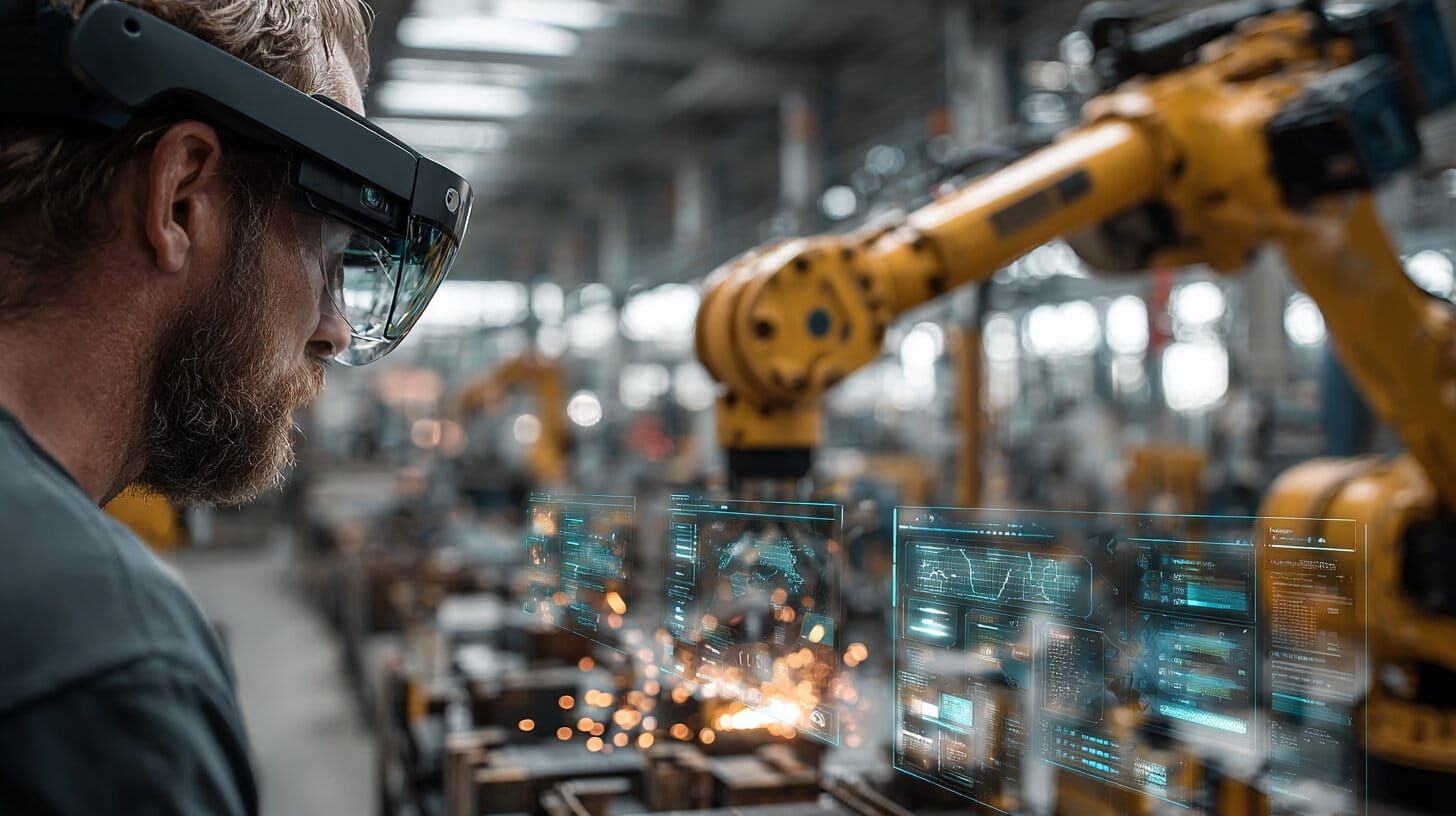
Perhaps the most direct smart tech application for upskilling manufacturing workers is AR training. AR headsets overlay digital information onto the physical world, giving real-time guidance for complex tasks.
For manufacturing, uses are extensive. A new technician can see step-by-step instructions overlaid on equipment. An operator learning assembly can follow visual guides highlighting each component. A quality inspector can view specs and data without checking separate documents.
PTC, a leader in industrial AR, says the technology helps manufacturers “improve workforce efficiency, reduce costs, and combat the skills gap.” Training times shrink dramatically. Error rates fall. New workers reach full productivity far faster.
This approach fits how modern workers prefer to learn. The MTC survey found 40% of manufacturing workers prefer hands-on learning. Only 11% of Gen Z employees prefer solely online training. AR combines hands-on immediacy with digital scale.
The Made Smarter Opportunity
The government has committed major resources to speeding digital adoption through Made Smarter. Having invested £112 million in grants and secured over £200 million in industry co-investment over five years to April 2025, the programme is now going national.
The government has set aside up to £16 million in 2025–26 to extend Made Smarter to all nine English regions. Plans include working with Scotland, Wales, and Northern Ireland. The programme offers SME manufacturers access to expert advisors, digital roadmapping, match-funded grants, leadership training, and workforce development.
For manufacturers unsure where to start their smart manufacturing journey, Made Smarter provides a structured entry point with funding and expert support.
Cross-Generational Learning: The Hidden Multiplier
Smart technology must go hand in hand with knowledge transfer between generations. MTC research reveals positive attitudes: over 90% of manufacturing workers are comfortable learning from older colleagues. Some 76% are happy to be taught by younger colleagues.
This willingness creates chances for structured cross-generational learning. Younger workers bring digital fluency and openness to new tech. Experienced workers offer deep domain expertise and practical know-how. Combining these strengths—with smart technology as an enabler—speeds skills development for both groups.
FANUC, a global automation leader, shows how this works. At their UK operations, apprentices work with experienced engineers in a culture of collaboration. Learning from colleagues with decades of robotics experience provides knowledge “far beyond textbooks.” Meanwhile, senior engineers say working with apprentices keeps them sharp and brings new ways of thinking.
The key is intentional design. Rather than leaving knowledge transfer to chance, create structured mentoring. Pair new hires with experienced workers. Use smart technology to capture institutional knowledge before it leaves.
Building Your Smart Skills Strategy
For manufacturers ready to address their skills gap through smart manufacturing, several practical steps can speed progress.
Audit your skills exposure. Map which roles are most at risk from retirement, recruitment difficulty, or technological change. Focus technology investment where the skills gap is most acute and business impact greatest.
Start with high-impact, low-barrier applications. Predictive maintenance can often deploy on existing equipment with minimal disruption. AR training can pilot for specific processes before wider rollout. Cobots can start on single workstations before scaling.
Leverage available support. Made Smarter offers substantial help for SMEs. Contact your regional Made Smarter team for a digital roadmap and explore match-funded grants.
Design for human-machine partnership. The best smart technology enhances human capability rather than eliminating human involvement. Involve frontline workers in technology selection. Their insights will improve outcomes and speed adoption.
Capture knowledge systematically. Use smart technology to document expertise from your most experienced workers. AI can learn from expert behaviour. AR modules can embed best practices. Digital work instructions can preserve knowledge for future workers.
Invest in foundational digital skills. Smart manufacturing needs baseline digital literacy across your workforce. Ensure all workers can access training in digital skills, data interpretation, and working with intelligent systems.
The Productivity Imperative
The UK’s Industrial Strategy positions advanced manufacturing as a key growth sector, aiming to nearly double annual business investment to £39 billion by 2035. Microsoft and Public First estimate AI could boost UK GDP by £550 billion by 2035. These depend on actions taken today.
For individual manufacturers, the maths is simple. Every unfilled vacancy means lost output. Every productivity gap versus automated rivals erodes margin. Every skilled worker who retires without sharing knowledge makes the problem harder.
Smart manufacturing offers a path through this challenge. Not a silver bullet, but a powerful set of tools that can multiply your workforce’s effectiveness, speed up skills development, and cut reliance on scarce talent.
The manufacturers who thrive in the coming decade will embrace this opportunity now. The manufacturing skills shortage UK faces is not going away. But smart technology can ensure it does not hold your business back.
Continue the conversation in the LeanIQ Hub
A unified intelligence platform for UK manufacturing and industrial professionals. From aerospace to automotive, supply chain to skills: curated news, verified peer discussion, and supplier discovery in one place.
Start Exploring