Next Generation Manufacturing UK: The Strategic Blueprint
The message from Business Secretary Peter Kyle at the Make UK National Manufacturing Conference could not have been clearer: next generation manufacturing UK must embrace is not optional. It is a strategic imperative.
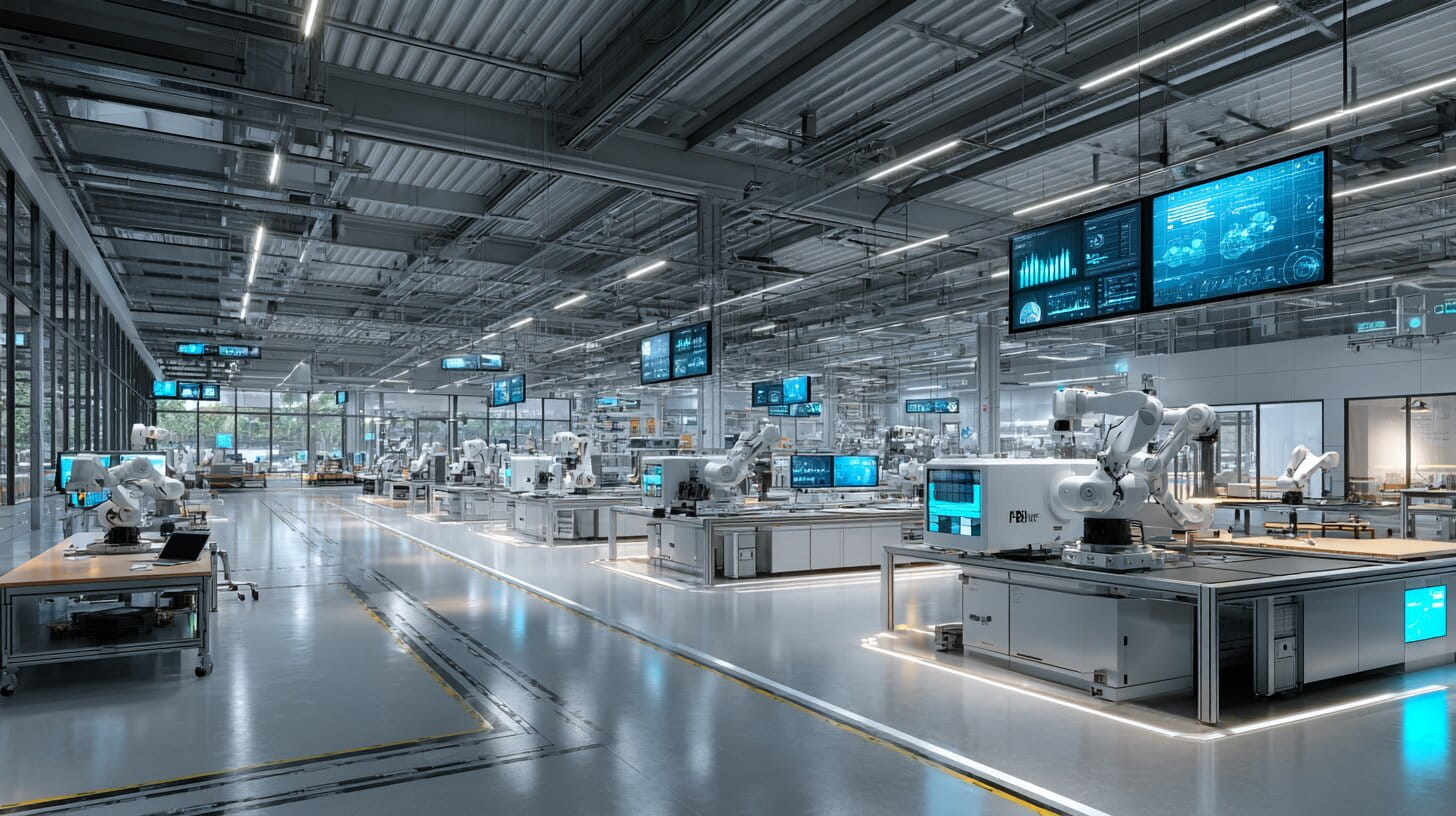
The message from Business Secretary Peter Kyle at the Make UK National Manufacturing Conference could not have been clearer: next generation manufacturing UK must embrace is not optional. It is a strategic imperative.
Speaking to hundreds of manufacturing leaders in what he called “a challenging moment for our economy,” Kyle laid out the government’s vision for transforming British manufacturing. The timing matters. As global supply chains shift and competitors race to secure industrial supremacy, UK manufacturers face a stark choice: modernise fast or risk being left behind.
This article examines what next generation manufacturing means in practice for UK firms. We explore where the sector currently stands and what operations directors need to do to position their businesses for the decade ahead.
What Is Next Generation Manufacturing?
Next generation manufacturing UK represents a fundamental shift in how products are conceived, produced, and sold. It encompasses three interconnected capabilities: advanced design technologies, smart production systems, and integrated service delivery.
Conception: The Digital Design Revolution
Value in modern manufacturing is increasingly captured at the design stage. This happens long before any physical production begins. Artificial intelligence, digital twins, advanced simulation, and data-driven engineering are transforming how products are imagined and optimised.
As Kyle noted, “The factory of the future begins not on the shop floor, but on a high-performance computer.”
Rolls-Royce is pioneering digital twin manufacturing in aerospace engine design. They use virtual replicas of physical components to predict performance and identify potential failures. BAE Systems integrates advanced modelling and AI into complex defence platforms. This reduces development time and improves reliability.
These are not isolated examples. According to Rockwell Automation’s State of Smart Manufacturing Report, digital twin adoption among UK manufacturers has jumped from 21% to 37% in the past 12 months alone. This makes the UK the European leader in this technology. A further 35% plan to adopt digital twins within the next year.
Production: Smart Factories and Intelligent Systems
The production element of next generation manufacturing involves integrating robotics, AI-driven process control, additive manufacturing, and connected sensors across factory operations. This is where smart manufacturing UK capabilities become critical.
The UK’s position here is mixed. While progress has been significant, there remains a substantial gap between British manufacturers and global leaders. The International Federation of Robotics reports that UK robot density stands at approximately 101 industrial robots per 10,000 manufacturing workers. Compare this to the global average of 162, Germany’s 429, Japan’s 419, or South Korea’s world-leading 1,012.
This automation gap represents both a challenge and an opportunity. For manufacturers willing to invest in manufacturing automation UK, the competitive advantage from catching up could be substantial.
Utilisation: Products as Services
The third pillar reflects how manufacturing increasingly extends beyond physical goods into integrated services. Modern products are bundled with software, data analytics, and maintenance contracts.
Kyle used the aerospace industry as an example: “An aircraft engine today is not merely sold as hardware. It is sold as ‘power by the hour,’ a service model where performance is monitored digitally and maintenance is predictive.”
This servitisation of manufacturing is where profit margins are increasingly won. Manufacturers who can combine advanced engineering with digital service provision will capture more value in their markets.
The UK’s Current Position: Strengths and Gaps
A government-commissioned report from Cambridge Industrial Innovation Policy provides the most comprehensive analysis yet of UK manufacturing’s economic contribution.
The findings are significant. Taking a broader view of manufacturing that includes its wider value chain, the sector contributed an estimated £331 billion to the UK economy. It supported around 4.3 million jobs in 2022. This is substantially higher than traditional measures suggest.
However, the report also identifies a critical challenge. The UK’s relatively modest manufacturing footprint compared with similar economies reflects both a smaller industrial base and weaker domestic value-chain linkages. In plain terms, UK manufacturing depends more on imported components and is less integrated with domestic supply chains than competitors.
UK Manufacturing AI Adoption: A Mixed Picture
On artificial intelligence, UK manufacturing AI adoption presents a complex picture. Among mid-to-large manufacturers, adoption varies dramatically by sector:
- Automotive leads with 60% AI adoption and maximum maturity scores. Companies use machine vision for quality control, predictive maintenance for robotics, and real-time supply chain optimisation.
- Electronics and high-tech follows at 55% adoption. They deploy AI for yield optimisation, smart sensors, and defect detection at microscopic levels.
- Aerospace and defence shows 50% adoption. This is concentrated among larger prime contractors using AI-powered design optimisation and non-destructive testing.
- Food and beverage shows only 20% adoption despite being one of the UK’s largest manufacturing sectors. However, growth is accelerating rapidly.
Office for National Statistics data reveals a starker picture for smaller firms. AI was adopted by just 5% of manufacturing businesses overall in 2023, compared to 9% in services. The gap between leaders and laggards is widening.
Positively, 53% of UK manufacturers are now using AI or machine learning in some capacity. 98% are either using or planning to implement generative AI. The Rockwell survey shows the UK leading Europe in applied artificial intelligence. For a deeper dive into UK manufacturing AI adoption trends, see our detailed analysis.
Government Support: What’s Available
The government has launched several initiatives to accelerate technology adoption among manufacturers. Understanding what’s available is essential for any modernisation strategy.
Made Smarter Adoption Programme
The Made Smarter programme provides fully funded specialist advice, leadership training, skills development, and match-funded grants of up to £20,000 for hardware and software purchases. Originally piloted in the North West, the programme is now rolling out nationally across all nine English regions in 2025-26. Expansion to Scotland, Wales, and Northern Ireland is planned from 2026-27.
The programme supports adoption of:
- Robotics and process control automation
- Industrial Internet of Things (sensors)
- Artificial intelligence and cognitive learning
- Data and systems integration
- Additive manufacturing (3D printing)
- Virtual, augmented, and mixed reality
- Industrial cybersecurity
Early results are promising. One manufacturer reported an 11% increase in productivity after monitoring machine downtime. Another achieved a 25% increase in overall equipment effectiveness (OEE), reduced waste by 56%, and lowered energy consumption by 4%.
Made Smarter Innovation Programme
For larger-scale technology development, the Made Smarter Innovation programme has received up to £37 million in funding for 2025-26. This supports collaborative research and development projects between manufacturers, technology firms, and academic institutions.
British Industrial Competitiveness Scheme (BICS)
Set to launch in April 2027, BICS will provide energy cost relief for energy-intensive manufacturers. This addresses one of the sector’s most pressing competitive disadvantages. UK industrial electricity prices remain 125% above the EU median.
Skills Investment
The government has pledged over £1 billion in tailored sector skills packages, including:
- Technical Excellence Colleges for engineering skills
- Growth and Skills Levy-funded short courses in digital, AI, and engineering launching from April 2026
- An Advanced Manufacturing Upskilling and Reskilling Programme
- Apprenticeship reforms cutting approval times from 18 months to 3 months
The Skills Challenge: A Ticking Clock
Technology investment alone is not enough. The UK manufacturing sector faces a skills crisis that threatens to undermine modernisation efforts.
Research from ECITB predicts that nearly 20% of the current UK manufacturing workforce will retire by 2026. This represents a massive loss of institutional knowledge and practical expertise.
Manufacturing apprenticeship starts showed only a 0.6% increase last year, reaching 46,070. While any growth is positive, this pace is too slow to replace retiring workers. It certainly cannot support the additional skills required for next generation manufacturing UK transformation.
A Nestlé-commissioned report identified a particular challenge with Generation Z. While young people possess digital skills that smart manufacturing UK needs, there is a significant perception gap. Manufacturing careers are often seen as outdated or unappealing. The reality is increasingly high-tech, well-paid roles.
As Kyle emphasised, “The engineer of the future must be as comfortable with AI as with machinery. They must be as fluent in data as in design.”
Practical Steps for Manufacturing Leaders
What should operations directors and manufacturing leaders do with this information? Here are concrete actions to consider.
1. Audit Your Digital Maturity
Before investing in new technology, understand your current position. Where are your data systems? How clean and connected is your operational data? The Cambridge report identifies data readiness as a key factor separating leaders from laggards.
The Made Smarter programme offers free digital transformation workshops and diagnostics. These can provide an objective assessment of your starting point.
2. Start With High-Impact Pilots
Rather than attempting wholesale transformation, identify specific processes where technology adoption can deliver measurable gains. Predictive maintenance, quality inspection using machine vision, and production scheduling optimisation are common starting points.
Siemens’ Congleton plant demonstrates what’s possible. AI predicts machine tool wear up to 36 hours in advance. This prevents costly unplanned downtime and increases production output.
3. Access Available Funding
Match-funded grants of up to £20,000 from Made Smarter can significantly reduce the upfront cost of technology adoption. The programme also provides free specialist advice to help you identify the right technologies for your specific challenges.
For larger projects, Made Smarter Innovation funding and Innovate UK competitions offer substantial support for collaborative development.
4. Address Skills Proactively
With the new Growth and Skills Levy short courses launching next month, manufacturers have new options for upskilling existing staff. These cover digital, AI, and engineering skills directly relevant to next generation manufacturing.
Consider partnering with Technical Excellence Colleges and universities. BAE Systems, with over 5,100 apprentices, demonstrates how large-scale skills investment can be integrated with business operations.
5. Think Beyond Production
Review opportunities to add service elements to your products. Remote monitoring, predictive maintenance contracts, and data-driven optimisation services can transform one-time sales into recurring revenue streams. They also deepen customer relationships.
The Competitive Imperative
Kyle’s speech placed UK manufacturing within a clear global context. The European Union is investing heavily in semiconductor resilience. The United States has passed landmark legislation onshoring critical supply chains. East Asian economies continue to lead in robotics density and advanced electronics production.
“The question is not whether this transformation in manufacturing will occur,” Kyle stated. “It is whether Britain will shape it. Or be shaped by it.”
For individual manufacturers, the calculation is similar. Companies that integrate AI, smart production systems, and digital services across their operations will pull ahead. They will gain on efficiency, product quality, and market responsiveness. Those that delay risk losing relevance.
The positive news is that UK manufacturing possesses genuine strengths. These include world-class research institutions, deep capital markets, a history of innovation, and growing government support for modernisation. February’s PMI data showed manufacturing output growth at a 17-month high. New orders rose from both domestic and international markets.
The foundation is there. The question is execution.
Looking Ahead
The government’s Modern Industrial Strategy sets an ambitious target. By 2035, the UK should be recognised as the best place in the world to start, grow, and invest in advanced manufacturing.
Achieving this will require sustained commitment from both government and industry. The sector plans and support programmes now in place provide a framework. But delivery depends on manufacturers taking action.
For operations directors and manufacturing leaders, the next 12 to 24 months are critical. Technology adoption timelines, skills development needs, and competitive positioning decisions made now will determine which companies thrive in the next generation manufacturing UK era.
The strategic imperative is clear. The support is available. The only remaining question is whether UK manufacturers will seize the opportunity.
Key Takeaways
- Next generation manufacturing UK encompasses advanced design (AI, digital twins, simulation), smart production (robotics, IoT, automation), and integrated services (monitoring, predictive maintenance, analytics)
- UK robot density at 101 per 10,000 workers trails the global average of 162 and leaders like South Korea (1,012) and Germany (429)
- Digital twin manufacturing adoption has jumped from 21% to 37% in 12 months, making the UK the European leader
- 53% of UK manufacturers are now using AI or machine learning, with 98% planning generative AI adoption
- Made Smarter programme offers free advice, diagnostics, and match-funded grants up to £20,000 for technology adoption
- Nearly 20% of the manufacturing workforce is expected to retire by 2026, creating urgent skills challenges
- Growth and Skills Levy short courses in digital and AI launch April 2026
- February 2026 PMI showed output growth at a 17-month high, indicating sector momentum
Continue the conversation in the LeanIQ Hub
A unified intelligence platform for UK manufacturing and industrial professionals. From aerospace to automotive, supply chain to skills: curated news, verified peer discussion, and supplier discovery in one place.
Start Exploring