On-Site Solar and Battery Storage for UK Factories: The 2026 Business Case
Why UK Manufacturers Are Turning to On-Site Generation
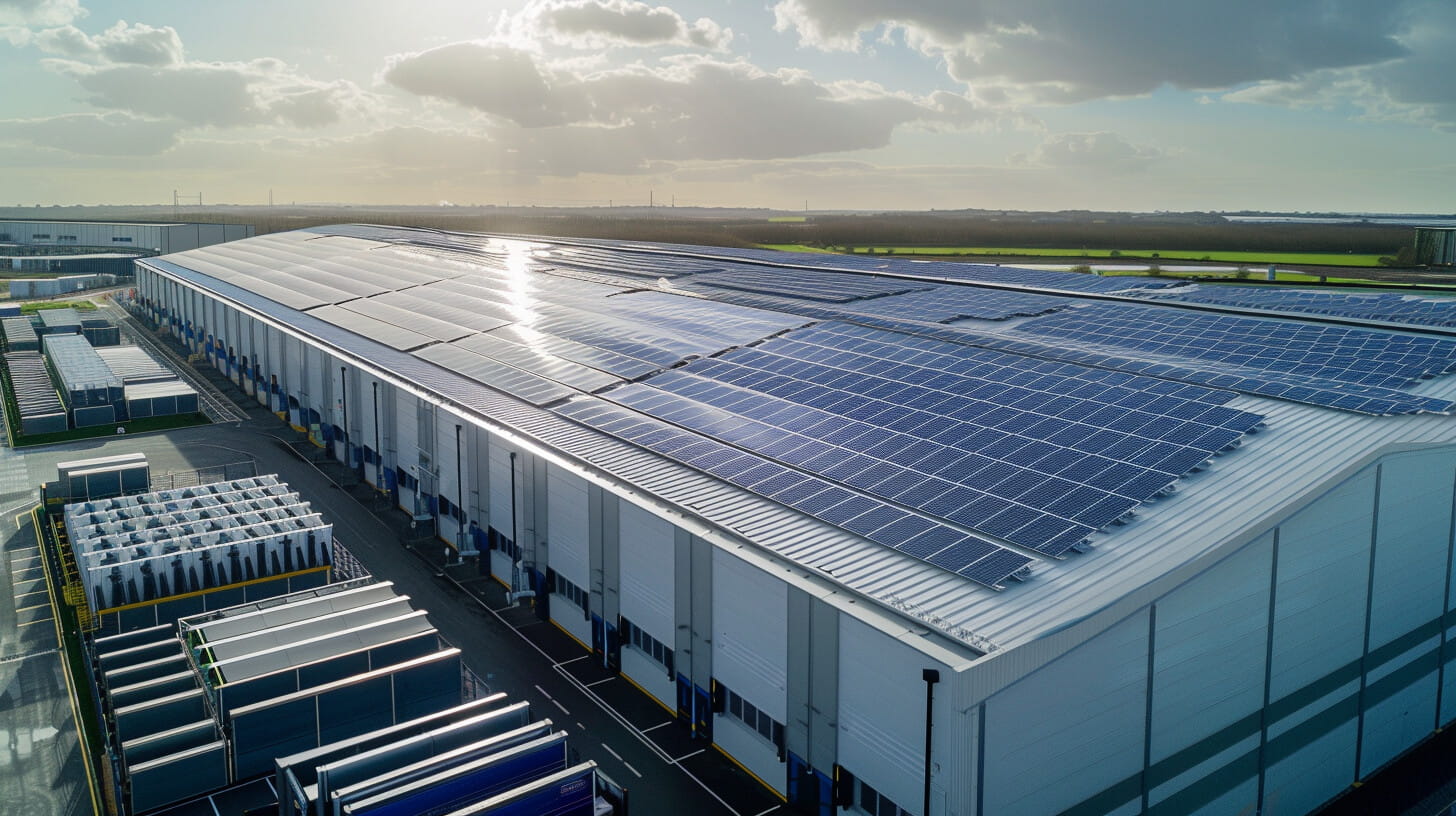
Why UK Manufacturers Are Turning to On-Site Generation
For UK manufacturers, electricity is not merely an overhead. It is a strategic input that directly shapes competitiveness, margins, and long-term viability. And right now, that input costs far too much.
As of the first half of 2025, large industrial electricity users in the UK pay an average of 25.33p per kWh, some 125% above the EU-14 median of 11.25p per kWh, according to data analysed by energy researcher David Turver using Eurostat figures. UK Steel’s latest report confirms that even with targeted relief, UK steelmakers face prices of £59.48 per MWh compared to £52.04 in Germany and £47.76 in France. For energy-intensive manufacturers, this price gap is not an inconvenience. It is an existential threat.
The government’s Clean Power 2030 Action Plan targets 45 to 47 GW of solar capacity nationally, up from approximately 18.1 GW installed as of March 2025. But manufacturers cannot afford to wait for grid-level reform. On-site solar and battery storage offer something the grid cannot: price certainty, immediate cost reduction, and operational resilience that starts delivering from day one.
This article sets out the 2026 business case in full: what it costs, what it saves, how the tax system supports it, and how to avoid the pitfalls that derail poorly planned projects.
The Numbers: What On-Site Solar Actually Costs in 2026
Commercial solar installation costs have fallen steadily, with the average cost per kilowatt dropping a further 2.4% between September 2024 and September 2025, according to the Federation of Master Builders citing government data. For a factory-scale installation, the figures break down roughly as follows.
A 100 kWp rooftop system, suitable for a mid-sized manufacturing facility, typically costs between £70,000 and £85,000 fully installed. Larger systems of 250 kWp and above benefit from economies of scale, bringing the per-kWp cost down further. At this scale, payback periods of three to five years are realistic for manufacturers with high daytime consumption, according to analysis by Infinity Energy.
For context, a 100 kWp system generates approximately 85,000 to 100,000 kWh per year in the UK, depending on location, orientation, and shading. At an avoided grid cost of 20p per kWh, that translates to annual savings of £17,000 to £20,000 before any export income.
The return profile is compelling. Simple annual ROI for commercial solar systems in the UK currently sits at 14% to 20% for smaller installations, rising to 20% to 33% for systems above 250 kWp. Internal rates of return (IRR) of 10% or more are common for well-designed projects, a figure that would satisfy most capital allocation committees.
Battery Storage: Costs and the Case for Pairing
Battery energy storage systems (BESS) add another dimension to the business case. In 2025, commercial battery storage costs sit at approximately £200 to £450 per kWh installed, with a typical 100 kWh system costing between £20,000 and £40,000. These costs have fallen 30% to 40% since 2022 and continue to decline as lithium-ion manufacturing scales globally. Ember’s October 2025 assessment of recent auction data puts all-in BESS project capex at $125 per kWh for large-scale projects.
For manufacturers, batteries serve three distinct functions. First, they store excess solar generation for use during evening shifts or overnight processes, increasing the proportion of solar energy consumed on-site rather than exported at lower rates. Second, they enable peak shaving, reducing maximum demand charges that can constitute a significant portion of industrial electricity bills. Third, they provide backup power resilience, keeping critical processes running during grid outages.
When paired with solar, battery systems typically achieve payback periods of four to seven years, with the strongest returns for facilities running two or three shifts.
The Tax Incentive Landscape: What Manufacturers Can Claim
The current UK tax framework is unusually favourable for on-site energy investment, though the detail matters. Several schemes interact, and getting the classification right is critical.
Annual Investment Allowance (AIA)
The AIA allows businesses to deduct 100% of qualifying capital expenditure from taxable profits in Year 1, up to a limit of £1 million. For most factory-scale solar installations, the entire cost falls within this threshold. At the current corporation tax rate of 25%, a £100,000 solar installation generates an immediate tax saving of £25,000.
50% First-Year Allowance for Larger Investments
For installations exceeding £1 million, a 50% First-Year Allowance (FYA) is available on the balance. This is relevant for larger multi-site rollouts or combined solar-plus-storage projects.
A critical point of clarification: HMRC classifies solar panels as “special rate” assets, not “main rate” assets. This means they do not qualify for the 100% Full Expensing relief that applies to main rate plant and machinery. The distinction is frequently misrepresented by installers and even some accountants. The AIA remains the primary route for most manufacturers.
Business Rates Exemption
Since April 2023, eligible on-site renewable energy generation and storage equipment, including rooftop solar panels and co-located battery storage, has been exempt from business rates. This exemption runs until 31 March 2035. For a large rooftop installation, this exemption can save thousands of pounds annually over the system’s lifetime.
VAT
Commercial solar installations are subject to standard rate VAT at 20%, which is reclaimable for VAT-registered businesses. This is straightforward for most manufacturers but worth confirming for any partially exempt entities.
Funding Routes: Capex Purchase vs. Power Purchase Agreement
Manufacturers broadly face two funding models, each with distinct financial profiles.
Direct Capex Purchase
Buying the system outright maximises long-term returns. You own the asset from day one, claim all available capital allowances, and retain 100% of the energy savings and export income. For businesses with available capital or access to asset finance at reasonable rates, this is typically the superior option over a 25-year system life.
Power Purchase Agreement (PPA)
A PPA allows a third party to install, own, and maintain the system on your roof at zero upfront cost. You pay only for the electricity generated, typically at 10 to 15p per kWh, which is less than current grid prices and fixed or predictably escalating over the contract term. The trade-off is clear: you sacrifice long-term ownership and maximum savings in exchange for zero capital outlay and zero maintenance responsibility.
For manufacturers whose capital is better deployed on production equipment, or for those with constrained balance sheets, PPAs provide a pragmatic route to lower energy costs without balance sheet impact.
Real-World Precedent: JLR’s 18 MW Gaydon Installation
The business case is not theoretical. In August 2025, Jaguar Land Rover unveiled an 18 MW solar PV installation at its Gaydon headquarters, spanning 26 hectares with the capacity to generate up to 31% of the site’s electricity. A separate installation at the company’s engine manufacturing facility became operational in May 2025, generating over 50% of its monthly energy consumption within the first months of operation.
JLR is also progressing plans for 18,000 solar panels at its Halewood manufacturing plant, with canopy structures across the site providing solar generation, EV charging infrastructure, and sheltered parking. The Halewood installation alone will have a generation capacity of approximately 8,600 MWh, covering roughly 10% of that site’s energy consumption.
These are not marginal projects. They represent a fundamental shift in how major manufacturers approach energy procurement, moving from pure grid dependency to a hybrid model where on-site generation forms the baseload.
Smart Export Guarantee: Monetising Surplus Generation
Any electricity generated but not consumed on-site can be exported to the grid under the Smart Export Guarantee (SEG). As of early 2026, the best fixed SEG rates sit at approximately 13 to 15p per kWh, with time-of-use tariffs offering up to 29p per kWh during peak hours (4pm to 7pm).
For manufacturers, SEG income is typically a secondary benefit rather than a primary driver. The real financial value lies in displacing grid electricity at 20 to 25p per kWh rather than exporting at lower rates. System design should therefore prioritise maximising self-consumption, with battery storage playing a key role in shifting surplus daytime generation into evening and overnight use.
That said, for facilities with weekend shutdowns or seasonal production patterns, SEG income provides a useful revenue floor during low-consumption periods.
Practical Considerations for Factory Installations
The financial case is strong, but successful implementation requires attention to several practical factors that are specific to manufacturing environments.
Roof Condition and Loading
Factory roofs must be structurally assessed before installation. Solar panels add approximately 10 to 15 kg per square metre of loading. Older industrial buildings may require reinforcement, which adds cost and complexity. A structural survey should be commissioned early in the feasibility stage to avoid surprises.
Electrical Infrastructure
Large solar installations require a Distribution Network Operator (DNO) application and may necessitate upgrades to the site’s electrical infrastructure, including switchgear and metering. DNO applications can take several months, so this should be initiated early. For installations above 50 kW, an export application is typically required even if you intend to consume the majority of generation on-site.
Planning Permission
Rooftop solar on commercial and industrial buildings generally falls under permitted development rights, meaning planning permission is not required in most cases. However, there are exceptions for listed buildings, conservation areas, and installations that protrude significantly above the roofline. Ground-mounted arrays on industrial land will typically require a full planning application.
Panel Degradation and Maintenance
Modern solar panels degrade at approximately 0.5% per year or less, meaning a system retains over 87% of its original output after 25 years. Maintenance requirements are minimal: periodic cleaning, annual inverter checks, and monitoring system performance to identify any underperforming panels. Budget approximately £500 to £1,500 per year for ongoing maintenance on a 100 kWp system.
MCS Certification
To qualify for the Smart Export Guarantee and certain capital allowances, installations must be carried out by an MCS-certified installer. This is non-negotiable and should be confirmed before engaging any contractor.
Building the Business Case: A Step-by-Step Framework
For operations directors and finance teams preparing an investment case, the following framework provides a robust structure.
Step 1: Quantify current energy consumption and cost. Gather at least 12 months of half-hourly consumption data from your supplier. Identify your blended cost per kWh, peak demand charges, and any capacity charges.
Step 2: Assess available roof space and orientation. Commission a desktop feasibility study to determine the maximum installable capacity. South-facing roofs at 30 to 40 degrees yield the best results, but east-west configurations can also work well and may better match morning and afternoon production schedules.
Step 3: Model self-consumption rates. This is the most critical variable. A factory running a single daytime shift may self-consume 50% to 70% of solar generation. A facility running 24/7 with battery storage could achieve 80% to 95%. Higher self-consumption means faster payback.
Step 4: Calculate net present value (NPV) over 25 years. Include capital cost (net of AIA tax relief), annual energy savings, SEG export income, maintenance costs, panel degradation, and an assumed electricity price escalation of 3% to 5% per year.
Step 5: Compare against alternatives. Benchmark the solar investment against other uses of capital, including production equipment, automation, or simply holding cash. A well-designed solar project with an IRR above 10% will compete favourably with most alternative investments.
Step 6: Obtain at least three quotes from MCS-certified installers with demonstrable industrial experience. Request detailed generation forecasts based on your specific roof geometry and shading analysis, not generic estimates.
The Strategic Case: Beyond the Spreadsheet
The financial returns alone justify the investment for most manufacturers. But the strategic benefits extend further.
Energy price volatility is not going away. The UK’s structural electricity price premium over European competitors reflects policy choices, grid infrastructure costs, and carbon pricing mechanisms that will persist for years. On-site generation provides a hedge against this volatility, locking in a portion of your energy cost at a fixed, predictable rate for 25 years or more.
Supply chain and customer pressure on carbon credentials is intensifying. Scope 2 emissions reporting under frameworks like the Streamlined Energy and Carbon Reporting (SECR) regime means energy consumption is visible to investors, auditors, and customers. On-site solar directly reduces reported Scope 2 emissions with fully auditable data.
And there is the resilience factor. Grid constraints are tightening across the UK, with connection queues stretching years into the future. Manufacturers who invest in on-site generation now secure their energy supply before grid access becomes even more constrained.
Key Takeaways
- UK industrial electricity at 25.33p per kWh, 125% above the EU median, makes the case for on-site generation self-evident.
- A 100 kWp factory rooftop system costs £70,000 to £85,000 and typically pays back in four to six years, with annual ROI of 14% to 25%.
- Battery storage at £200 to £450 per kWh enhances returns through peak shaving, increased self-consumption, and operational resilience.
- The AIA provides 100% Year 1 tax deduction on investments up to £1 million, and business rates exemption runs until 2035.
- Solar panels are HMRC “special rate” assets, so do not qualify for Full Expensing. Get specialist tax advice before claiming.
- Maximise self-consumption through battery storage and system design matched to your production schedule.
- Commission structural and electrical surveys early, and initiate DNO applications before committing to installation timelines.
The window for action is clear. Costs are at historic lows, tax incentives are generous, and the electricity price gap with European competitors shows no sign of narrowing. For UK manufacturers who have not yet explored on-site generation, the question is no longer whether to invest, but how quickly you can get panels on the roof.
Continue the conversation in the LeanIQ Hub
A unified intelligence platform for UK manufacturing and industrial professionals. From aerospace to automotive, supply chain to skills: curated news, verified peer discussion, and supplier discovery in one place.
Start Exploring